2008-05-27

Technical Analysis

What is Technical Analysis?

“Technical analysis” is an industry term that more often than not sounds much more complicated than the actual process is. Really, it ought to be referred to as “price analysis”, as this would be a more accurate description. Through the use of charted data traders around the world analyze their market of choice. The objective: determine future price movement. The means: understanding price movement patterns of the past.

The charting of price movements creates a visual tug-of-war between buyers and sellers. The large majority of Technical traders in the Forex market focus their attention on candlestick data, a method of charting that offers a visual interpretation of the high, low, open and close of a currency price within a certain time frame.


Combined with various forms of pattern recognition , candlestick charting offers traders a visual look at the market’s past prices and trends. Analyzing this historical data in order to predict the movements of future prices is the process known as “technical analysis”. Notice how price patterns formed on the following chart tend to repeat; technical traders attempt to identify patterns of these nature, and base their trades accordingly. ( view figure 1 )
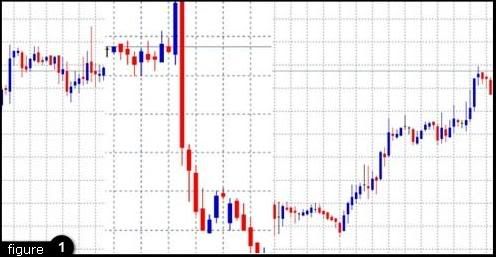

Figure 1


Why Does Technical Analysis Work?


Technical analysis is often dispelled as a myth, even a fool’s errand. There are those who believe that price movement is completely random and completely unpredictable. True, technical analysis is never an exact science (predicting the future never is). However, the true fool would be he or she that ignores the power of technical analysis, particularly in the Forex market.


Analyzing price patterns is actually very similar to analyzing human behavior. While humans can at times be unpredictable in nature, humans are typically considered to be creatures of habit. The average human adheres to certain paradigms, paradigms that are rarely broken. Do you brush your teeth or shower first? Do you comb your hair before or after you shave? The point: if one were to observe an average person’s daily routine before leaving the house for work their behavior may seem random or without purpose. However, if one were to observe the same human day after day, within a relatively short amount of time it would not be hard to outline that person’s morning routine. In fact, nine times out of ten you would probably be able to predict with impressive accuracy how your observed creature would prepare for their day, perhaps even down to the minute.


The Forex market is also a creature of habit. Analyzing price movement is effective because the past can teach us how human beings (the real living and breathing organism of this market) will react to certain situations. History does repeat itself. Technical analysis offers the Forex trader a certain level of expectancy when considering future price movements. In a sense, accurate technical analysis is a trader’s true edge. There is no crystal ball for predicting the future of the market, though there are keys to understanding patterns, past, present and future.


When Does Technical Analysis Fail?


Technical analysis fails when traders fail to consider the fundamentals. Why mention fundamental analysis when explaining technical analysis? Simple, the one just doesn’t work without the other. Fundamental factors such as political events, a hike in interest rates, unemployment rates and so on will impact the Forex market more substantially than perhaps any other market. Fundamental factors are often the driving force of major price movements. A trader focused on technical analysis cannot ignore Nonfarm Payroll on the first Friday of the month and expect his or her technical indications to be as accurate as the day prior. Notice the price movement shown in the following image; shortly after Nonfarm Payroll price reactions were wild; during such times technical analysis cannot be counted on. ( view figure 2 ) Purely technical traders understand that certain political factors throw all other price forecasts out the window.
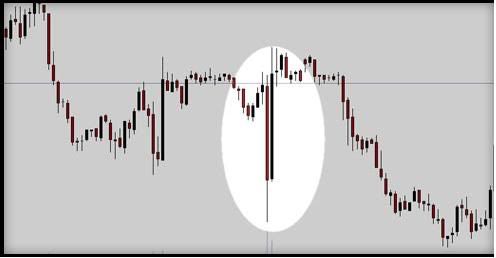
Figure 2


2008-05-24

List of forex news sources

Looking for Forex News?

Here is the list of some print and web Forex news sources: (listed in an arbitrary order).

ABC News—updates its news several times a day and updates Forex news several times a week. Tends to cover the major events in the world of Forex.
ForexHelp.com—focuses in full length on one major story. Afterwards, it focuses shortly on a few top Forex topics. Then it provides Forex news, which are updated a few times a day. All information is relevant.
Bloomberg.com—provides high quality news. Divides information into several categories to ease your reading. Covers important social, political and economical data.

Reuters—is an excellent source of information. Focuses on worldwide news, has a large global appeal due to its many international offices. News is constantly updated. Offers a lot of Forex news.
MarketWatch, Inc—belongs to Dow Jones & Company, Inc. Provides radio updates every half hour—accessible via their website. Also, is a good provider of special reports.
The Wall Street Journal; The Wall Street Journal Online—provides business news and financial information on a daily basis, including analysis. The site is divided into sub-sites as per the different continents; there are different web versions for the different continents.
BBC NEWS—provides news about all subjects, always in a fresh and professional manner. In their “Economy” section you will find various kinds of economical issues. Search the site for whatever you are looking for and you will surely find it.
The Financial Times Review/ FT.com—report excellently about business. News is updated several times a day. Forex news is updates once a day.
CNBC.com—leads in business news and provides fresh and real-time market coverage. Website offers videos.
CNN.com—is a leader of news both domestically and internationally. Extremely professional, clear, and well written. Forex news can be found on the site, however it is not updated daily. All information on it is relevant and useful.
The Washington Post—reports on many issues and does so in the highest quality. Their “Business” category is large and you will find many interesting articles there.
Guardian Unlimited—covers Forex news, but is not dedicated to it. Does contain much financial, business, economic news. All news is professional, well written, and pleasurable to read.
FX Week—is a good source of Forex news as it focuses on Forex. Provides commentary on Forex technology, strategy, currencies, etc. However most of the information is limited to subscribers only.
Business Week/BusinessWeek.com—leads in business news. Provides news in a wide range of categories, very interesting articles, and has a good search engine.


Risks involved in forex trading

In Forex, emotions can be your worst enemy. Fear, excitement, panic, anticipation can lead you to make a trading decision impulsively, or rush you into a transaction. And oftentimes, this can be not only risky, but also damaging, harmful, and destructive. Trading Forex should be rational, calculated, and well thought through. While making smart decisions does not guarantee a success (it can lead to failed transactions as well) it still allows traders to trade with control. And controlling one’s own trading fate, is a positive thing!

Any investment requires risk taking. Risk is an exposure to the chance of loss. Loss can happen in many ways: it can happen via the change in the price from the closing time of a trading day to the opening time of the following trading day, it can happen as a result of a country’s increasing unemployment rates, or as a result of someone misinterpreting the graphs. Unfortunately, it has happened that people trade and trade their funds, trade on large amounts of leverage, yet cannot back their transactions up, and hence end up losing a lot of money. In this sense, the Forex market is said to be addictive, and in many ways trading is said to be gambling.


How to attempt to limit loss? How to make a smart decision? Educate yourself.

• Not all online games involve real money. Some trading platforms allow you to play without having to risk any money. This means that you cannot win any money, but it also means that you cannot lose any. It does mean that you get to practice your trading skills.
• Use Forex simulations to get hands-on experience without having to risk any money.
• Take classes. Participate in seminars. Join webinars. Attend conferences. Learn the basics of economy and finance.
• Get risk management consultation and advice.
• Inform yourself about Forex strategy tools. Learn how to strategize and how to control risk.
• Trade with a fixed money management strategy. Know what percentage of the account you are willing to risk on any given day. You want your trades to be controlled, disciplined, responsible and always well managed.


Forex Scams


Unfortunately, Forex scams exist. Individuals are led to believe that they can expect to make huge amounts of money by trading in the Foreign Exchange market, when in fact, they cannot. Just as unfortunate is the fact that the amount of Forex scams has increased drastically in recent years. The market is not as regulated as it should be, which allows for such scams and frauds to take place. Moreover, when individuals have been scammed it is oftentimes difficult to prove that such scams took place.

Forex scams come in various forms (and sizes…) When you visit and use Forex websites and/or Forex software be aware of brokers who don’t always tell the truth about the risks involved in trading, of platforms that manipulate the exchange rate, of consultants that don’t look out for your best interest. Look out for programs that supposedly trade on your behalf and always make profits, for programs that provide inaccurate analysis, and automated trading services. Be aware of any trading platforms that promise that there is no risk involved and that this specific program can make you lots and lots of money.

Always double check “facts” and/or promises that you get and find about if they are correct. Make sure to get plenty of information from various different sources, and of course, make sure that you trade on a secure, reliable, safe platform as to guarantee your safety. Be suspicious as to avoid being scammed!


2008-05-23

Forex Scalping

Scalpers… never heard about them? I’m not surprised...because scalpers are a new breed of traders.

The leading principle behind scalping is that smaller price movements are easier to catch than large ones. And the movement is said to usually be of the following nature: a price movement goes in the trader direction for a while before it goes in its trend direction!

So what do scalpers actually do?

Well… they open and close positions in minutes or seconds attempting to make a profit that way. In a single day, scalpers will open and close tens and even hundreds of positions! They try to make many small profits with small price changes.

Scalpers will trade on leverage and hence increase their risk. However, since the trade is for a really short period of time, the risk decreases. It can be said that scalping is in a way a “risk control” strategy.

However, let’s not forget two thing: 1) The spread that you pay… when you open a trade it makes it more profitable to trade long-term, and 2) Since the gain is so minimal, one major loss could eliminate all the other gains, which could be not only extremely frustrating, but also financially destructive!!

Voila, this is Scalping!